CLIMATE IS MORE THAN CO₂
ON THE BLIND SPOT OF A DEBATE THAT THINKS TOO SMALL ABOUT THE LIVING WORLD
“We need to reduce CO₂” is a sentence repeated so often that it almost sounds like a law of nature. It is correct and significant. Fossil fuels have brought carbon that had been bound in geological reservoirs for very long periods of time back into the active cycle within just a few generations. CO₂ is a climate-active gas. Anyone who denies this is making it too easy for themselves.
But anyone who concludes from this that the climate crisis is essentially a matter of CO₂ accounting is also making it too easy for themselves. Perhaps even easier.
Because then climate becomes a number, landscape becomes a sink, soil becomes a storage unit, forest becomes a certificate, garden becomes a climate calculator, and nature becomes an Excel spreadsheet with a floral border. Suddenly we believe we have understood what we are in the process of destroying.
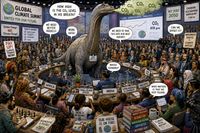
If an elephant stood in the room during the neophyte debate, then in the current climate debate a Brontosaurus has long been sitting in the plenary chamber - and everyone is discussing the CO₂ content of its breath.
THE WELL-MEASURABLE PARTIAL VIEW: CO₂
Today’s climate debate has one great strength. It has made the effects of greenhouse gases visible and has shown that the atmosphere is not simply an empty space above our heads, but a sensitive system. It has made the responsibility of fossil fuels politically nameable. These are good and important developments.
But it also has a weakness, because it narrows our view. It turns a highly complex, living, water-borne, biological, geological and atmospheric process into a predominantly physical and chemical question. How much CO₂ is in the air? How many tonnes are emitted? How many tonnes are bound? How many tonnes are compensated? How many tonnes are we still allowed to emit?
That sounds precise, scientific and controlled.
Yet it is only a partial view of the overall problem. A partial view can become dangerous when it is mistaken for the whole.
A look at current temperature developments is unsettling. The Copernicus temperature trend monitor of the European Union’s renowned Earth observation programme is not an oracle and not a climate model, but a statistical extrapolation of observed temperature trends. For precisely that reason, it should not be misunderstood as an exact prediction. But nor should we casually ignore what it shows:
The current statistical date (June 2026) at which the 1.5-degree mark is reached is January 2029, and it has moved significantly forward compared with earlier estimates. In 2015, for example, the year of the Paris Climate Agreement, the estimate for reaching the 1.5-degree mark was the year 2042. Such temperature pathways and projections also shaped the political horizon of expectation surrounding the Paris Climate Agreement.
Now, only 11 years later, the estimate has shifted 13 years forward; from 2042 to 2029. This shift is not a small correction mark at the edge of a diagram, but an indication that the observed warming dynamic raises serious questions about our understanding, our weighting and our political communication - especially since the increase in greenhouse gases over the last 11 years remains within the projected ranges.
This is not about questioning whether CO₂ has a climatic effect, because that is very well established scientifically.
It is about asking whether we understand climate sufficiently when we organise almost everything around CO₂.
Greenhouse gas emissions have remained far too high since the Paris Climate Agreement. That is undisputed. But they have not suddenly multiplied like a bad science-fiction plot beyond every expected order of magnitude. Aerosols explain part of the recent warming, El Niño explains part of it, and changes in shipping, clouds, albedo, ocean heat and internal climate variability also play a role. Climate science is working intensively to understand these interactions better.
Precisely because these interactions are complex, an open society should not only defend its models, but also expand its questions.
Perhaps CO₂ is not wrong, but simply not the whole film.
Possibly, CO₂ is the well-measurable protagonist of a much larger epic in which we may have overlooked the direction: life itself.

THE LIVING PLANET
The Earth is not a dead stone with a little gas above it. It is a living planet. Its atmosphere is not simply there. It has been altered, rebuilt and co-shaped by microbes, algae, plants, fungi, soils, oceans, weathering, calcification, photosynthesis, respiration, decomposition, sedimentation and countless feedbacks that we can partly measure, but hardly fully understand.
For a long time there was life without much oxygen. Then photosynthetic organisms began to rebuild the atmosphere. What was a catastrophe for many early forms of life became the precondition for new development for others. Later, plankton, shell-forming organisms, forests, moors, fungi and microorganisms continued to reshape the carbon cycle. Life did not simply take its place on a finished planet. It helped shape that planet.
This is Earth history, not romantic nature mysticism.
And this history has a consequence: climate is not only physics and chemistry, but also biology.
Life is not merely the victim of climatic conditions; it also has a climate-forming effect of its own. Life changes the atmosphere, water balance, soil, surfaces, albedo, cloud formation, evaporation, carbon storage, nutrient cycles and temperature buffering. It can stabilise, shift, amplify or dampen conditions. This does not always happen gently, harmoniously or without ruptures, crises and mass extinctions. Yet over long periods of time, it has been remarkably successful.
One might say: life is this planet’s great feedback artist.
And it is precisely this artist that we so often treat today as a background extra.
NO CO₂ WAREHOUSE WITH WOODPECKERS
In the CO₂ debate, life usually appears as a storage medium. Forest stores carbon. Soil stores carbon. Moor stores carbon. A garden perhaps also stores a little carbon, if you harass it with a climate calculator for long enough. This view is not completely wrong. But it is pitifully small.
A forest is not a CO₂ warehouse with woodpeckers. Soil is not a carbon account with earthworms. A garden is not an offsetting instrument with lavender. A moor is not an emissions-avoidance object, but a living, wet, metabolising system.
Living landscapes do not only store carbon. They cool, evaporate and shade. They build soil, hold water, slow runoff, create roughness, feed microbes, close nutrient cycles, create dew, moisture, transitions, habitats, fungal networks, root layers, insect spaces, bird food, humus, pores and pore dwellers. They distribute solar energy differently from asphalt, bare fields, gravel surfaces or dry roof skins.
Anyone who steps out of a forest onto an asphalt road on a hot summer day does not need a climate model to understand the difference. The CO₂ concentration above one’s head has barely changed. And yet the climate of one’s own body changes immediately. In the forest there is shade, evaporation, soil moisture, air movement, smell, life. On asphalt there is stored heat, hard radiation, dryness, overheating.
At that moment, the difference does not lie in the global atmosphere. It lies in the surface.
Now let us think this principle on a larger scale.
When forests disappear, soils dry out, wetlands are drained, rivers are straightened, landscapes are sealed, microbes are damaged, fungal networks are destroyed, seas are over-fertilised and cultural landscapes are simplified, then we do not only lose species. We lose important climate functions such as feedbacks and the capacity of living surfaces to channel solar energy into evaporation, growth, soil formation and cycles.
Heat is then buffered less and remains more strongly at the surface.
This does not replace the effect of CO₂. But it explains why a climate debate that stares only at CO₂ is too small.
CO₂ affects the global radiation balance. Water, soil, vegetation and living surfaces help determine how heat becomes effective regionally and locally: whether it is buffered, distributed, evaporated, shaded and integrated into living processes - or whether it further charges hard, dry, overheated surfaces.
THE BLIND SPOT
This is the blind spot of the CO₂ debate.
It asks how much greenhouse gas is in the atmosphere. It asks far less often which living processes we have destroyed that regulate water, heat, carbon and nutrients.
It asks how much CO₂ a garden binds. It asks far too little whether the soil is alive, whether water remains, whether shade emerges, whether evaporation is possible, whether insects find food, whether fungi are at work, whether people are learning again not to cut off immediately everything that does not fit their image of control.
It asks how much electricity a PV system produces. It hardly asks why it lies on a living meadow while roofs, car parks and facades continue to stand around as dead technical surfaces.
It asks how much retention volume a basin has. Unfortunately, it does not ask why a living pond with a woody fringe, mud, shade and amphibians has become a lifeless water container with a maintenance plan.
It asks how much CO₂ can be compensated. It does not ask what has been simplified, controlled, tamed, certified and sterilised in the process.
The problem is not that we measure. Data can help. Without data, we would not recognise many connections. The problem begins where we confuse the measurable with the essential.
CO₂ is measurable. Tonnes are comparable. Certificates are tradable. Tables are politically convenient. A number is reassuring because it creates the impression that one has the matter under control. Living systems, by contrast, are messy. They develop. They elude us. They contradict us. They are not always clean, not always plannable, not always photogenic and certainly not always compatible with funding logic.
A wild garden fits badly into an Excel spreadsheet. A fungal network does not write an impact report. A stream with eroding banks looks less orderly on a plan than a straight profile. A pond with leaves and deadwood appears neglected to some eyes. A brown lawn in high summer may be ecologically more sensible than a green lawn kept alive with drinking water. But our culture loves the controlled surface, the number, the proof and the certificate.
Even where it says “eco”, it often still thinks industrially.
That is perhaps the bitterest punchline: the ecological movement is increasingly adopting the very mode of thinking it should actually be overcoming. Nature is no longer destroyed only because it is not valued. It is also destroyed because it is valued too narrowly.
The forest becomes a carbon sink, the garden a CO₂-binding area, the soil a humus store, the meadow a potential site, the stream a hydraulic line and the fallow land an unused resource. Nature may remain if it provides a measurable service. If it is self-willed, complex, slow, wild or contradictory, it is optimised.
And optimisation is often only a more polite word for destruction with a better form.
USE TECHNICAL SURFACES, UNDERSTAND LIVING SURFACES
Of course we need renewable energies. Of course fossil fuels must be phased out of the system. Obviously, a PV system on a roof is more sensible than a roof without a PV system. A roof is already a technical surface. It can generate electricity, retain water, be greened, host habitats for insects and birds and reduce urban heat. That is multiple use.
But a living meadow is not an empty surface just because no technology is standing on it yet. It is already active: it evaporates, it buffers climate, it feeds, it roots through the soil, it transforms, because it lives. If such a meadow is, for example, built over with a PV system, then living processes of that meadow are degraded.
Technology belongs first on technical surfaces. Living surfaces must be understood as living surfaces.
The same applies to gardens. If one wants to calculate a near-natural garden through its CO₂ binding, one may have a modern tool, but not yet a better understanding. For a small garden, gathering reliable data would be so time-consuming that afterwards one would probably no longer have time to enjoy it. Soil type, initial humus content, water balance, root biomass, cuttings, compost management, woody plant development, maintenance behaviour, peat content, machinery, substrates, decomposition, microclimate, change of use - all of this would have to be recorded seriously. In the end, one would get a number that looks more exact than it is.
And what would have been gained?
Perhaps one would then know that the garden mathematically binds a few kilograms more or less CO₂. But one would still not know whether children are again observing beetles there, whether the soil smells after rain, whether coolness emerges in summer, whether water infiltrates, whether the blackbird finds food, whether the person who tends this garden is once again entering into a relationship with their place.
A society that recognises the value of a garden only through a CO₂ calculator does not have too little data. It has too little relationship.
And that is exactly the point.
A CRISIS OF PERCEPTION
The climate crisis is not only a technical crisis. It is also a crisis of perception. We have learned to count molecules, but we have forgotten how to see living connections. We can balance emissions, but can hardly distinguish anymore whether a landscape is alive or merely painted green. We can certify “climate neutrality” while soils become compacted, streams impoverished, gardens sterilised and water disappears from the land.
CO₂ is not unimportant in this story. But CO₂ is not life. And climate is not only CO₂.
When deserts expand, when land surfaces dry out, when oceans overheat, when precipitation fails regionally or turns into heavy rainfall, when soils lose their pores, when forests die, when fungi, microbes and insects disappear, then it is not enough to point only to the ppm number in the atmosphere. One must also ask what is happening to the living surface of this planet.
Water is not a sideshow here. Water is the central medium of living climate regulation. As water vapour it acts in the atmosphere, but as soil moisture, plant water, evaporation, dew, cloud, rain and runoff it acts in landscapes. It transports, cools, dissolves, evaporates, condenses, buffers and connects. Through plants, soils, clouds, dew, evaporation and precipitation recycling, water links the atmosphere with the landscape. When water no longer remains in the land, when it no longer circulates through vegetation, soil and atmosphere, the landscape loses its climatic dampening capacity.
A dry surface is not only a surface with less water. It is a surface with less climate function.
And a biologically impoverished surface is not only a surface with fewer species. It is a surface with less feedback.
Perhaps this is the decisive difference between a CO₂-centred and a living understanding of climate. CO₂-centred thinking asks how we can reduce a harmful number. Living thinking additionally asks how we can strengthen the processes that make life possible.
The first often leads to substitution: new car, new technology, new balance sheet, new certificate, new compensation. The second leads to repair: holding water, building soil, strengthening vegetation, closing cycles, unsealing surfaces, greening roofs, using technical surfaces in multiple ways, making streams more alive, controlling gardens less, making agriculture more water-sensitive, keeping nutrients in the region instead of losing them through rivers into the sea and later replacing them with mining and energy expenditure.
The first way of thinking tries to make the existing system climate-neutral. The second asks whether the system is life-friendly at all.
That is a substantial difference.
Because a system can be optimised in terms of its CO₂ balance and still be wrong for the landscape; a measure can be mathematically green and ecologically dull; a project can be certified and still damage living relationships. Not every reduction in CO₂ is automatically climate protection if it weakens water, soil, vegetation and life.
That does not merely sound uncomfortable; it is uncomfortable. Nevertheless, such discussions are necessary if we take climate protection seriously.
A DIFFERENT MEASURE
We do not need climate protection that dissects the living world into key figures and then optimises the key figures. We need climate protection that makes the living world the measure again.
This does not mean less science. It means asking better questions.
It is not enough to ask how much CO₂ is saved. We must also ask where the water remains, how the soil lives, what evaporates, what cools, what roots, what shades, what decomposes, what builds up, what remains in the cycle, what becomes more alive and what has merely become more technical, smoother, cleaner, more calculable and poorer.
The blind spot of the climate debate is not that it takes CO₂ seriously. The blind spot is that it takes the living world too little seriously.
The rise in CO₂ is an important signal that atmospheric equilibria have changed, but it is not the planet.
The planet is water, soil, air, fungus, alga, leaf, animal, microorganism, sediment, cloud, shade, decomposition, evaporation, root, light and time. It is a web of processes. A living relationship. A shared world, not merely an environment.
If we want to protect climate, it is not enough to reduce emissions. We must also strengthen the living feedbacks that have helped shape climate over long periods of time and have made habitable conditions possible.
This does not begin only in the atmosphere.
It begins where rain falls, where water infiltrates, where soil lives, where plants evaporate, where fungi connect, where microbes work and where people stop taking nature seriously only when it can be calculated.
Perhaps this is the real imposition of the climate crisis: it demands not only new technology; it demands a different relationship with the living world.
And mastering this challenge is more difficult than buying a new electric car.
SOURCES, LINES OF THOUGHT AND SCIENTIFIC BACKGROUND
This essay does not understand itself as a counter-position to climate science, but as an expansion of the field of view. It takes the physical effect of greenhouse gases seriously, while also asking about those living processes that receive too little attention in many public climate debates: water balance, evaporation, soil life, vegetation, land use, microorganisms and the climatic role of living surfaces.
The basic climate-scientific foundation is provided by the Sixth Assessment Report of the Intergovernmental Panel on Climate Change, in particular its Summary for Policymakers. It clearly states the human influence on the warming of the atmosphere, oceans and land. The Global Temperature Trend Monitor of the Copernicus Climate Change Service was also used in relation to the temporal approach towards the 1.5 °C threshold discussed in the text. It is not a climate model and not an oracle, but a statistical extrapolation of observed temperature trends — and precisely for that reason, it offers a remarkable indication of the dynamics of the present.
IPCC: Climate Change 2023 – Synthesis Report. Summary for Policymakers.
Download/online: https://www.ipcc.ch/report/ar6/syr/downloads/report/IPCC_AR6_SYR_SPM.pdf
Accessed: 4 July 2026.
Copernicus Climate Change Service: C3S Global Temperature Trend Monitor.
Online: https://apps.climate.copernicus.eu/global-temperature-trend-monitor/
Accessed: 4 July 2026.
For the perspective on Earth and atmosphere as systems shaped by life, the classic paper by James E. Lovelock and Lynn Margulis on the Gaia hypothesis stands in the background. What matters here is not a romantic idea of Earth as a harmonious organism, but the sober thought that life does not merely inhabit the atmosphere, material cycles and planetary conditions, but has helped shape them over long periods of time.
James E. Lovelock / Lynn Margulis: Atmospheric homeostasis by and for the biosphere: the Gaia hypothesis. Tellus, 1974.
Online: https://tellusjournal.org/articles/10.3402/tellusa.v26i1-2.9731
Accessed: 4 July 2026.
A central line of thought concerning the relationship between water, landscape and climate leads to Wilhelm Ripl and Hermann Scheer. Their Memorandum on Climate Change belongs to those texts that consistently shift the view from the emissions question alone to the living surface of the Earth: to evaporation, vegetation, soil, regional water cycles and the question of how landscapes organise heat, water and nutrients.
Wilhelm Ripl / Hermann Scheer: Memorandum zum Klimawandel, 2007.
Download/online: https://matricultura.org/pdf/Ripl-Scheer_memorandum-klimawandel.pdf
Accessed: 4 July 2026.
Works on forests, water and climate are also important. David Ellison and colleagues show that forests do not merely store carbon, but are deeply embedded in regional and supra-regional climate processes through evaporation, cooling, cloud formation, precipitation processes and energy flows. Gordon Bonan further describes how forests influence the energy balance, the water cycle and the atmosphere through physical, chemical and biological processes.
David Ellison et al.: Trees, forests and water: Cool insights for a hot world. Global Environmental Change, 2017.
Download/online: https://hal.science/hal-01517232/document
Accessed: 4 July 2026.
Gordon B. Bonan: Forests and Climate Change: Forcings, Feedbacks, and the Climate Benefits of Forests. Science, 2008.
Download/online: https://sites.bu.edu/cliveg/files/2020/08/01-Bonan-science-2008.pdf
Accessed: 4 July 2026.
For the often overlooked field of soil life and microorganisms, one important reference is the international statement Scientists’ warning to humanity: microorganisms and climate change. It reminds us that microorganisms are not decorative side figures of ecological systems, but central actors in carbon, nitrogen, methane, oxygen and nutrient cycles.
Ricardo Cavicchioli et al.: Scientists’ warning to humanity: microorganisms and climate change. Nature Reviews Microbiology, 2019.
Online: https://www.nature.com/articles/s41579-019-0222-5
Accessed: 4 July 2026.
For the practical connection to water retention, evaporative cooling and near-natural landscape water balance, German-language publications by the German Environment Agency were also consulted. They show why water retention, evaporation, greening, unsealing and an approach towards natural water balances are key components of climate adaptation and natural climate protection.
German Environment Agency / Umweltbundesamt: Effektiver Landschaftswasserhaushalt, 2026.
Download/online: https://www.umweltbundesamt.de/system/files/medien/479/publikationen/2026-03/KBU_Effektiver_Landschaftswasserhaushalt.pdf
Accessed: 4 July 2026.
German Environment Agency / Umweltbundesamt: Untersuchung der Potentiale für die Nutzung von Regenwasser zur Verdunstungskühlung in Städten, 2019.
Download/online: https://www.umweltbundesamt.de/system/files/medien/1410/publikationen/2019-09-16_texte_111-2019_verdunstungskuehlung.pdf
Accessed: 4 July 2026.
The essay therefore follows a simple but far-reaching question: What happens when climate protection takes CO₂ seriously, but thinks too small about water, soil, vegetation, microbes, fungi, surfaces and living feedbacks? The sources listed here do not provide a simple answer. But they open the space in which this question can be asked meaningfully.
The illustration of the dinosaur in the plenary hall was created with the help of ChatGPT 5.5 in the “resonance space of resistance”.
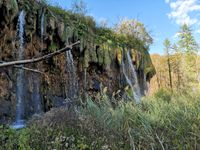
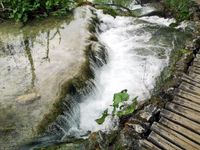
The other images are photographs from a field trip to the impressive Plitvice Lakes in Croatia in 2024. These lakes could only develop and persist in this form because the surrounding landscape, with its near-natural primeval forest areas, functions as an exemplary system of decentralised water retention.