ENTROPY–SYNTROPY
The Earthworm in the Mega-Machine
On Life, the Universe, Biochar, Syntropic Agriculture and Almost Everything
Biochar, Terra Preta and syntropic agriculture are now regarded as bearers of hope for climate protection, soil-building and regenerative land use. But what happens when living soil processes are translated into a technical logic of storage?
This essay asks about the difference between carbon storage and fertility — and why an earthworm sometimes asks the better question than a certificate.
1. WHY SOIL DOES NOT ARISE FROM PROCEDURES
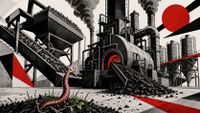
Let us imagine an earthworm in front of a pyrolysis plant.
A pyrolysis plant is, put simply, a furnace for biomass from which oxygen is withheld. Wood, straw, green waste or other organic residues are not burnt in it but charred at high temperature. What remains is biochar: black, porous carbon that can remain stable in the soil for a long time and is therefore now being discussed as a possible climate saviour.
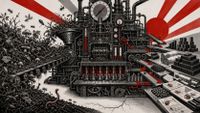
The earthworm, however, is not lying there in the damp darkness beneath a mulch layer, not among fungal hyphae, rotting leaves, roots, woodlice, springtails, bacteria and all the quiet workers of fertility. It lies in a world of stainless steel, conveyor belts, sensors, temperature curves, funding programmes, certificates, emissions balances and business models. Around it, biomass is dried, shredded, heated, charred, weighed, documented and perhaps eventually sold as a contribution to climate protection.
Everyone means well. Nobody must be evil. The engineers optimise the process. The funding body checks the evidence. The consultants explain the effect. The investors calculate with the market. The advertising finds beautiful images of black hands full of soil. And somewhere there is a word that sounds like the future: carbon storage.
The earthworm understands little of this. It has no access to the database, no opinion on certificates and no PowerPoint presentation about negative emissions. But perhaps precisely for that reason it asks the better question:
"Why are you taking away my food to make soil out of it?"
This question is not naive. It goes to the heart of the matter. Soil does not arise, first and foremost, from procedures. Soil arises from metabolism: from eating, digesting, excreting, growing, dying, being colonised by fungi, being penetrated by roots, aired, moistened, decomposed and connected. Soil is not a material one simply manufactures, but a living process organised through plants, animals, fungi, microorganisms, water, minerals, climate and time.
This article is therefore not simply about biochar. It is about a cultural preference: we often trust technical storage solutions more than the living processes that make soil possible in the first place — processes taken seriously, for example, in the approach of syntropic agriculture.
This question is not theoretical. It is highly topical. Biochar has long since ceased to be merely a topic for gardens, composting sites, Terra Preta seminars or ecological experiments. It has become part of European climate policy. Under the European framework for carbon removals and carbon farming, Biochar Carbon Removal can be certified as a permanent removal of CO2. This turns charred biomass into a possible vehicle for climate certificates, investments and business models.
This is where it becomes interesting. For it is no longer just a question of whether biochar can be useful in certain soils. Of course it can. Under certain conditions. From certain residues. In certain quantities. Incorporated into living composts, manures or substrates. But that is not the real question.
The real question is this:
Why is our culture so quick to stabilise carbon technically, while barely understanding the living processes that turn carbon into soil, roots, fungi, humus, water-holding capacity and fertility?
Or, more simply:
Why does our culture trust technical storage solutions more than the living processes that make soil possible in the first place?
This is where syntropy, or syntropic agriculture, comes into play. The term is now used frequently, often in the same circles in which biochar, Terra Preta, regenerative agriculture and carbon markets are promoted. Yet syntropy is not a decorative word for greener. Not a label for dense planting. Not a friendly mist over agroforestry plots, forest gardens and course programmes.
If the term means anything, then it is as a counter-question to entropy.
Syntropy does not ask: Does it look ecological?
Syntropy asks: Does management make more living order possible — or is impoverishment merely being technically stabilised, accounted for and sold?
This brings us to the true core of this text. Biochar is only the test case. The deeper questions are:
Do we begin with the living process — or with the machine?
With the soil — or with the certificate?
With the earthworm — or with the business model?
For the mega-machine has long since learnt to speak green.
2. THE MEGA-MACHINE LOVES THE MEASURABLE
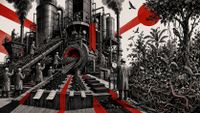
Today the mega-machine no longer arrives only with smoke, steel and concrete. It arrives with climate targets, certifications, sustainability reports and neatly designed diagrams. It does not necessarily wear overalls anymore. Sometimes it wears a linen shirt, speaks of resilience, biodiversity and transformation.
That does not automatically make it wrong. It only makes it harder to recognise.
Lewis Mumford, one of the most clear-sighted critics of technological civilisation in the twentieth century, did not use the term mega-machine simply to describe a large technical installation. He meant something more fundamental: a form of organisation in which people, machines, administration, capital, science, politics and ideology are coupled into an apparatus. A machine whose components are not only cogs, engines and computers, but also forms, standards, funding programmes, insurance tariffs, research applications, certificates, business models and advertising images.
The mega-machine is therefore not most dangerous where it is loud. It is most effective where it becomes self-evident. Where no one any longer asks why a living process must first be translated into a metric before it counts as real. Where soil is only taken seriously once it appears as a carbon store. Where a forest no longer begins as a forest, but as a biomass reserve, a risk class, a CO2 sink, a timber reserve or a compensation area.
It is not simply evil. That would be too easy. The mega-machine can build bridges, organise hospitals, plan water pipes, fight epidemics and coordinate processes. Without technical and organisational systems there would be no modern society. The problem begins where these systems no longer serve but reshape reality in their own image.
Then soil becomes a substrate. Biomass becomes a raw material. Water becomes a management problem. Fertility becomes a nutrient balance. Diversity becomes a metric. Landscape becomes a funding backdrop. Life becomes a data set.
This is the true art of the mega-machine: it does not always destroy openly. Often it merely translates. But this translation is never innocent. What cannot be measured, standardised, insured, certified or sold easily disappears. Not because it is unimportant, but because it fits badly into the columns.
The earthworm fits badly into the columns.
It works without a verification form. It eats and digests, mixes organic material with mineral soil, creates pores, improves water movement, aerates the soil and turns dead biomass back into fertility. It is not a product. It is not a measure either. It is part of a metabolism. For the mega-machine, this is inconvenient. An earthworm is not easy to scale, patent or sell as a permanent carbon removal. It does not even have a serial number. That is probably its greatest flaw.
Murray Bookchin, one of the formative thinkers of social ecology, saw the ecological crisis not merely as a problem of nature, but as a problem of society. The way a society treats nature is related to the way it organises power, control and coexistence. Those who see diversity as a disturbance tend to prefer control. Those who do not understand relationships replace them with administration. Those who cannot read living processes build procedures that pretend they can replace life.
This also applies to soil.
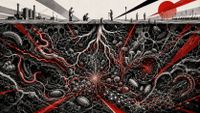
A living soil is not a clean apparatus. It is damp, dark, porous, contradictory, full of feeding channels, fungal threads, root tips, slime, casts, decomposition, birth and death. It is not a machine that only has to be adjusted correctly from the outside. It is more like a many-voiced space of metabolism. Its order is not the order of the spreadsheet. It is the order of relationship.
The mega-machine orders by simplifying. It breaks living contexts down into units that can be measured, steered, insured, funded and sold. That is its strength. And its danger.
Soil orders differently. It does not simplify; it becomes more complex. It does not turn plants, fungi, bacteria, animals, water, minerals and time into a clean plan, but into a breathing fabric. Its order is not the order of the spreadsheet. It is the order of metabolism.
The earthworm and the pyrolysis plant therefore do not simply stand for nature versus technology. The earthworm stands for an order that arises through digestion, relationship and living feedback. The plant stands for an order that arises through separation, heating, stabilisation and procedure. Both can be useful. But the difference is decisive: one order builds life. The other stabilises a substance.
It is precisely here that entropy and syntropy begin to become interesting.
Entropic is not simply the wild or the dirty. A system becomes entropic where relationships fall apart, energy dissipates, water runs off, soil lies bare, fertility declines, and impoverishment must be compensated for by ever new interventions.
Syntropic would be the countermovement: where life, with the help of usable energy, builds relationships, enlivens soil, holds water, organises diversity and allows use to create more livingness.
This shifts the question. It is no longer only about technology, politics or agriculture. It is about order itself. Why does it fall apart so easily? Why is disorder so probable? And why does life nevertheless keep bringing forth higher complexity — from usable energy, water, air, minerals and time?
To answer that, we must first briefly turn to entropy.
3. ENTROPY — OR WHY DISORDER IS THE EASIER PATH
To understand syntropic agriculture, it is not enough to look at dense plantings, pruning techniques or agroforestry systems. We must first go to the place where the term meets its resistance: entropy.
Entropy is not a poetic word for mess, but a concept from physics. More precisely: from thermodynamics. It sits at the centre of the second law. The first law says that energy does not simply disappear but is transformed. The second law goes one step further and asks in which direction these transformations run: usable energy becomes less usable, differences even out, heat disperses, order falls apart more easily than it arises.
Or more simply: energy is conserved. But its ability to do work is lost.
We experience entropy every day without calling it that. It lives in the kitchen too. No dishwasher has ever been observed to empty itself out of pure gratitude. No sock drawer develops a higher order after being ignored for long enough. No desk turns overnight into an archive system. Dust distributes itself more or less evenly through rooms and does not have the courtesy to organise itself into a tidy ball of fluff and hop into the bin by itself. Order is possible, but it needs energy. Disorder has the easier path.
Physically, this is only an image, but a useful one. It shows the direction. Ordered states are possible, but they are fragile. Without energy, attention and work, systems slip back into more probable states. The coffee cup falls from the table more readily than its shards reassemble themselves into a cup. The log becomes smoke, ash and heat more readily than smoke, ash and heat spontaneously decide to become a tree again.
This does not mean that order is impossible. It means only that order is less probable than disorder. It needs conditions. It needs flows of energy. It needs boundaries, structures, feedback and time.
The physicist Gerd Ganteför has taken up these questions impressively in his YouTube channel “Grenzen des Wissens” and in his book “Die Intelligenz des Universums”. Some of the images that follow — the dice, the pocket watch, the bacterium, and later the cautious speculation about information — are drawn directly from his reflections. They are not meant here as a finished formula for the world, but as thought images at the boundary between natural science and philosophy.
So let us take dice.
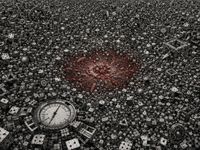
If a hundred dice lie on a table, there are countless ways in which their numbers can be distributed. It is possible for all one hundred dice to show a one. Nothing forbids it. But it is extremely improbable. A mixed distribution is far more likely: a few ones, a few twos, a few threes, fours, fives and sixes. Not because the universe has any personal aversion to order, but because there are many more ways to be untidy.
Entropy is precisely this statistical probability: most states are not beautifully ordered. Most states are mixed, distributed, evened out, blurred. High order is possible, but it is rare. And the more complex the order, the rarer it becomes if it is left to chance alone.
This matters because otherwise we underestimate life.
A leaf, a fungus, a bacterium, an earthworm, a forest, a living soil — none of these are banal things. They are local, highly complex orders in a universe that, statistically speaking, tends more towards distribution, equalisation and dispersal. Life is therefore not simply nature. Life is an event against the convenience of entropy.
But caution is needed: life does not abolish the second law. A tree is not a cosmic lawbreaker. An earthworm is not a small saboteur of thermodynamics, though it does show some talent for the role. Life can build order because it is not a closed system. It takes in usable energy, processes matter, gives off heat and waste, and maintains its internal order by exporting entropy outwards.
That sounds abstract, but it is very concrete.
A plant takes in light, carbon dioxide from the air, water from the soil and minerals from its surroundings. From these it builds sugars, cellulose, roots, leaves, flowers, fruits, wood, fragrances, defence compounds, mucilage and those unobtrusive root exudates with which it feeds microorganisms in the soil. It turns radiation into relationship, energy into metabolism, and air and water into form.
This is not magic. It is photosynthesis. But perhaps photosynthesis is only such a sober word because we have forgotten how tremendous, almost magical, the process is.
The same principle applies beyond sunlight. At hydrothermal vents in the deep sea, organisms live not from light, but from chemical energy gradients. There, no sun is captured; usable energy is drawn from sulphur, hydrogen, iron or other compounds. The decisive thing, then, is not always light. The decisive thing is free, usable energy: a gradient from which life can make work.
Syntropy begins to become interesting precisely here. Not as a mystical counterforce to entropy, not as a new salvation word for agricultural course programmes, but as the name of a direction: wherever open living systems take up usable energy and from it bring forth higher complexity, relationship, metabolism, fertility and self-organisation.
Entropy says: differences even out. Order falls apart more easily than it arises. Usable energy becomes less usable.
Syntropy asks: under what conditions can life nevertheless build order? When does energy become relationship? When does biomass become soil life? When does use become more fertility rather than less? When does cultivation become not consumption, but build-up?
And so, we return to the earthworm.
For the mega-machine, biomass is above all a substance that can be recorded, dried, heated, stabilised and accounted for. For the earthworm, biomass is food. For the soil, it is the beginning of a process. For life, it is not waste, but opportunity.
And precisely here it is decided whether agriculture merely compensates technically for entropic losses — or strengthens syntropic processes.
For a soil does not become alive because we deposit carbon somewhere for the long term. It becomes alive when energy enters relationship through plants, roots, fungi, animals and microorganisms. When water is held, when pores form, when food chains close, when what has died does not vanish but is transformed, and when residues do not become waste but metabolism.
The mega-machine seeks stability in the substance.
Life seeks stability in the process.
And perhaps that is where the difference between carbon storage and soil-building begins.

4. THE POCKET WATCH, THE BACTERIUM AND THE INSOLENCE OF LIFE
Let us imagine a pocket watch.
It lies on a table. Silver case, fine engraving, gears, axles, bearings, spring, escapement. A small mechanical universe. If we found such a watch on the Moon, we would hardly say: Ah, interesting, chance has apparently done a good job. A few molecules here, a few atoms there, enough time, and suddenly it ticks.
Nobody believes that. Not even very optimistic molecules.
A pocket watch points to order. To planning, precision, knowledge of materials, manufacture, assembly. Its existence seems improbable as soon as one sees it as a random collection of parts. And precisely for that reason it has for centuries been a popular image for the question of whether complex order presupposes an ordering process.
But now let us place a bacterium beside this pocket watch.
The bacterium has no polished case. No engraving. No hands. No pleasant ticking. Under the microscope it looks rather unspectacular, sometimes like a tiny dash with organisational ambitions. But this dash is alive. It takes in substances, converts energy, maintains its internal order, repairs damage, responds to its environment, reads genetic information, builds proteins, regulates membranes, divides and, when the opportunity arises, makes a copy of itself.
A watch with reproductive intentions would make any customs officer nervous.
The comparison is not meant to belittle technology. A good watch is a marvel of human precision. Its world is the world of cogs, springs and bearings. Its crucial accuracy lies, broadly speaking, in the realm of the finest mechanical manufacture. Tiny to our eyes, magnificent for craftsmanship.
A cell works deeper.
There, molecular shapes, charges, bonds, folding, enzyme pockets, membranes and ion channels decide between life and decay. These processes take place in molecular spaces, in orders of magnitude where the craftsmanship of mechanics no longer rules, but the geometry of chemistry. Between watch work and cell there lie not only different materials, but different depths of reality. Technology grips matter at the scale of manufactured parts. Life organises matter down into the atomic space of function.
The watch is built precisely.
The bacterium is far more precise — and alive.
And that is the decisive difference. Once a watch has been built, it only must function until it wears out. A bacterium must generate its order anew in every moment. It is not an object lying finished before us. It is a process that sustains itself. It does not simply fall apart because it is constantly working against this falling-apart. It is a small, damp, chemical assault on probability.
If one understands a bacterium as a merely random arrangement of atoms, it becomes absurdly improbable. Even more absurd than the pocket watch on the Moon. But this is exactly where the trap lies: life is not a finished random object. It did not arise because somewhere all the parts were shaken in a cosmic dice cup and someone suddenly shouted:
Congratulations, Escherichia coli!
Life is not a lottery win made of atoms.
It is a historical process. Chemical evolution, energy gradients, mineral surfaces, membranes, self-reinforcing reactions, precursors of metabolism, replication, variation and selection. Over unimaginable spans of time, systems could arise that stabilised themselves, copied themselves, changed, and passed on what worked. Life was not brought forth by purposiveness in the human sense, but by an interplay of energy, information, matter, chance, selection and time.
That makes life extremely astonishing and improbable. What is astonishing about life is not only that highly complex order exists. What is astonishing is that this order does not stand still. It does not even have to be perfect. It only must be good enough to continue. Life is not the rigid perfection of the watch. Life is robust improvisation with molecular precision.
Here entropy becomes important again.
A dead bacterium decays. Its membranes lose their order, enzymes denature, metabolic pathways break down, molecules disperse, chemical differences even out. What had just been alive becomes material again. The atoms are still there. The molecules perhaps for a while too. But the order that held them together has disappeared.
Life was not in the atoms alone.
It lay in their organisation, in their relationships, in their temporal sequences, in the feedback, in the information that made certain possibilities more probable than others. A bacterium is therefore not merely matter. It is matter in a state of organised activity.
Or more simply: life is not only something that is. Life is something that does.
The mega-machine has a problem with this. It loves objects. It loves substances. It loves stable units. It loves things that can be weighed, measured, counted, accounted for and stored. A gram of carbon is agreeable. A certificate is agreeable. A tonne of CO2 equivalent is manageable.
A living process is more difficult.
It has seasons, moisture, temperature, plant species, soil life, management mistakes, weather extremes, fungal networks, feeding traces, chance events, neighbourhoods and an inconvenient tendency not to do exactly what the project application said it would. Those who work with living systems do not work with obedient things, but with responding relationships.
This is precisely why the difference between carbon storage and soil-building is so fundamental.
Carbon storage asks: where does the carbon remain, how long does it remain there, and how can that be demonstrated?
Soil-building asks more: which processes hold water? Which roots open depth? Which fungi connect plants? Which animals open pores? Which microorganisms transform dead matter? Which use strengthens fertility rather than consuming it? Which order remains alive enough to keep renewing itself?
The pocket watch ticks as long as its mechanism remains intact.
The bacterium lives if it organises its improbability.
The soil lives if this organisation does not end in a single organism, but continues between many beings: in roots, fungi, bacteria, earthworms, insects, water, air, minerals and dead biomass that does not remain waste, but enables new fertility.
Perhaps this is precisely the insolence of life: it takes a universe in which disorder is the easier path and builds from its metabolism, form, memory, relationship and future.
Not outside entropy.
But against its easiest course.

5. LUCA — OR WHY THE BEGINNING WAS ALREADY NOT THE BEGINNING
If a bacterium is already such an insolence towards probability, the next question almost asks itself: since when has life been playing this game?
The answer is uncomfortably early.
LUCA is the name for the Last Universal Common Ancestor, the last common ancestor of all known cellular life today. The name sounds a little like a friendly person who lives on the second floor, but it does not mean a person, a fish, a fern or even a small green ancestor with a family album. LUCA was no great-grandfather in biological Sunday best. LUCA was a reconstructed fork in the tree of life.
More precisely: LUCA denotes the point from which the lines branched that later led to archaea, bacteria and ultimately also to us. All known cellular life today bears traces of this common origin: genetic codes, ribosomes, protein building blocks, energy currencies, molecular tools. For all our cultural vanity, we are distant kin of slime, crust, microbial film and everything that, in warm and chemically interesting niches, at some point decided not simply to fall apart again.
That is a frontal insult to the family-tree book in the bourgeois living room.
More recent reconstructions date LUCA to around 4.2 billion years before the present. The Earth itself is about 4.54 billion years old. If this estimate is correct, then the last common ancestor of all known cellular life appears only a few hundred million years after the formation of our planet. In geological terms, that is not a leisurely late-evening programme. It is early. Insolently early.
And again: LUCA was not the origin of life.
LUCA was already a result.
This is often overlooked. When people hear of LUCA, they easily imagine the first living point, the biological starting signal, the famous first cell sitting lonely in some primordial soup and probably not yet knowing what to do with its historical responsibility. But it is not that simple. LUCA is not the first spark, but the oldest node we can reconstruct reasonably well from life today. Before LUCA there must already have been a long prehistory: chemical evolution, molecules that stabilised themselves, reactions that reinforced themselves, membranes that separated inside from outside, energy gradients, mineral surfaces, early metabolic networks, variants, errors, selection, failure, repetition.
Most of that has vanished.
Not everything that once lived, or came close to life, left descendants. The early Earth was not an orderly archive. It was more like a laboratory without minutes, with occasional volcanic eruptions and very poor data backup. Many lines may have arisen and disappeared again. Many chemical pathways may have been tried without leading into our present. What we see today is not the whole story, but the line that remained.
Or more precisely: the line from which we, too, emerged.
Here the question of entropy and syntropy becomes sharper once again. For if LUCA was already relatively complex, then the riddle does not begin with animals, plants, forests or soils. It begins much earlier. At the beginning of known life there is not simple dead matter that happened to be neatly sorted, but a system that used energy, carried information, organised metabolism and passed on its order.
Life therefore does not appear as a finished object. It appears as continuing activity.
It takes energy gradients seriously. It does not simply reduce differences; it uses them. It turns chemical tension into work. Work into structure. Structure into repetition. Repetition into variation. Variation into history.
This is the moment when physics and chemistry also become biology.
Of course everything remains physical. No law is suspended. No thermodynamics is insulted. But within the physical world a new kind of order arises, not the rigid order of the crystal, not the technical order of the machine, but an order that maintains itself by changing. An order that does not simply exist but is continually renewed.
The crystal is ordered, but it does not live.
The machine is ordered, but it does not heal itself — at least not without a great deal of human indulgence, spare parts and occasional despair.
Life is different. It can turn errors into possibilities and test variation. It can make adaptation out of disturbance, niches out of limits, habitats out of energy gradients. It can fail, become extinct, begin again, branch off, cooperate, eat, be eaten, join and, over billions of years, bring forth, from single-celled ancestors, earthworms, forests, fungi, coral reefs and those strange beings that eventually build pyrolysis plants and then wonder whether they can use them to save the soil.
One must grant the universe a certain sense of irony.
LUCA is therefore not just a biological footnote. LUCA is an offence to any worldview that regards life as a late decoration on an otherwise dead planet. If known life had already reached such a complex level so early, then life was not some afterthought of the Earth. From the beginning it was one of the Earth’s great order-forming movements. A movement that does not stand against the laws of nature but develops from within them a new possibility: open systems that transform usable energy into metabolism, information, relationship and history.
It is precisely here that LUCA touches the question of syntropy.
In this context, syntropy does not mean that the world automatically becomes better, greener or more harmonious. The history of life knows extinction, catastrophes, dead ends, predation, decay and competition. But it cannot be reduced to struggle.
Lynn Margulis, one of the most important evolutionary biologists of the twentieth century and a pioneer of symbiotic thinking, pointed to precisely this with great persistence: evolution is not only the story of stronger individuals displacing weaker ones. It is also the story of symbioses, cooperation, mergers and dependencies from which entirely new forms of life could arise.
Perhaps this is one of the points at which the old story of nature as battlefield falls short. Life is not simply kind, and it is not simply brutal either. It is capable of relationship. And precisely there lies a great part of its creative force.
Under certain conditions, life can make build-up out of use, food out of residues, metabolism out of waste, diversity out of limits, organisation out of energy gradients and history out of time.
That is the line that leads from LUCA to living soil.
This transition is not direct, not clean, not romantic, but it is fundamental. Soil is not a thing that was added to the Earth at some point like a carpet laid over a planet. Soil is a late, multi-layered fruit of this long living history. It arises where rock, water, air, climate and organisms work together over long periods of time. Without life there would be weathering, dust, sediments, minerals — but no living soil in the proper sense: no crumb structure full of pores, root exudates, fungal networks, earthworm burrows or humus formation as the result of a many-voiced metabolism.
Soil is geology that has become biological.
Perhaps this is one of the most beautiful and dangerous thoughts in this whole text. For if soil is a product of living history, then it cannot be replaced at will by technical procedures. It can be supported, tended, stimulated, protected and nourished. It can also be destroyed: its pores crushed under heavy machinery, poisoned, dried out, overheated, and in a few decades ruined after having arisen over very long periods of time. But it cannot simply be manufactured like a building material.
One can mix substrates, stabilise carbon and produce biochar.
But living soil arises only where energy, water, air, minerals, organisms and time enter relationship.
LUCA reminds us how old this art is.
The mega-machine reminds us how quickly we believe we can shorten it.
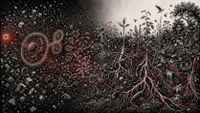
6. ERNST GÖTSCH — OR HOW A DIFFICULT WORD SUDDENLY BECOMES NECESSARY
After entropy, the pocket watch, the bacterium and LUCA, it sounds almost suspiciously simple to speak now of syntropic agriculture. As though, after a journey through thermodynamics, chemical evolution and four billion years of Earth history, one suddenly asked whether the apple tree had been pruned correctly.
Ernst Götsch, a Swiss agronomist and farmer, is regarded as the central figure of syntropic agriculture. He is not a theorist who invented an attractive term and then went looking for a form of agriculture to match it. He works in Brazil on degraded land and has spent decades developing systems that do not work against natural succession, but with it: not against growth, but with growth; not against weeds, but with the question of which plant can perform which task at which moment.
This shifts more than may at first appear. The spontaneous plant is not automatically the enemy, shade is not automatically a loss, biomass is not waste, and pruning is not merely maintenance. Agriculture is no longer the art of holding a site against its natural tendencies. It becomes the art of reading those tendencies in such a way that use, and build-up need not stand opposed.
There is a small, beautiful and perhaps not fully verifiable story about the emergence of the term syntropic agriculture. According to it, Götsch said in an interview, in essence, that an agriculture in which everything becomes more rather than less is syntropic — as a counter-term to entropic: more life, more fertility, more water, more biomass, more possibilities. The journalist turned this into: Ernst Götsch practises syntropic agriculture. And suddenly a term stood in the world that perhaps had never been intended as a brand name but no longer disappeared.
Syntropic agriculture is not, in this sense, a magic word. It is more demanding than many uses of the word regenerative, because it does not ask after the label, but after the direction of the process.
Does more living order become possible, or is an exhausted system merely stabilised by new interventions?
This question unmasks many familiar terms: a site can look green and still be ecologically poor. A project can sound biodiverse and still be based on control. An agroforestry system can appear complex and yet amount to little more than an industrial field with tree strips. Biochar can shine as climate protection while leaving open the question of whether the charred biomass would not have been more urgently needed within the living cycle — as digestible food for soil life.
Syntropy asks more deeply. It asks whether sunlight is being transformed into living relationships, whether the soil remains covered, whether plants work together across time, space and function, whether pruning triggers growth, whether biomass becomes food, whether water stays in the system for longer and whether diversity is not decoration but load-bearing structure.
For Götsch, pruning therefore plays a special role. Not as horticultural tidying-up, but as an impulse. A plant is pruned, and the system responds: light falls differently, roots react, microorganisms receive food, biomass becomes cover, cooling and protection. The plant is not considered in isolation, but as part of a temporal event.
A wrong cut is violence.
A right cut can be dialogue.
This is perhaps one of the hardest lessons for a culture that has learnt agriculture primarily as control. We have learnt to clean up areas, draw straight rows, eliminate competition and remove disturbances. Sometimes that is necessary. Often it is blind.
Syntropic thinking begins where one does not immediately ask: How do I get rid of this? But rather: What is this growth showing me? What task does this plant perform? What relationship does it make possible? When must I support it, when cut it, when take it back, when let it go?
This is not a romantic surrender to everything that grows. Syntropic systems are designed, pruned, guided and harvested. But the intervention should not stand against the living world; it should understand its direction. The human being is not the commander of the site. He is a participant in a process older and more intelligent than his plan.
Here Götsch touches again on the question of LUCA. If life has been using energy gradients, building relationships and making new possibilities out of disturbance for billions of years, then agriculture is not the invention of order on an empty surface. It is always an intervention in order-forming processes already present. The question is only whether we weaken these processes or strengthen them.
Entropic agriculture, by contrast, consumes the preconditions of its own production. It leaves soil bare, lets water runoff, reduces diversity, interrupts material cycles, replaces relationships with inputs and eventually wonders why ever more effort is needed to maintain ever less livingness. Then comes the next procedure to manage the consequences of the previous one.
Syntropic agriculture would be the counter-question: how can we use in such a way that the system becomes more alive, more water-holding, more diverse and more fertile?
These are very ambitious aims. But perhaps agriculture needs precisely these visions.
For an agriculture that merely minimises damage remains trapped in the thinking of damage. Syntropy asks differently: what becomes more?
More yield, more photosynthetic surface, more soil life, more water in the system, more organic matter in living processing, more resilience and more future viability.
This makes syntropy a test — and turns it into questions addressed to our culture:
Do we begin with the procedure or with the living process?
With the product or with the metabolism?
With the certificate or with the relationship?
The earthworm does not need the word syntropy.
It speaks fluent metabolism.
But perhaps we need the word because we have almost forgotten its language.
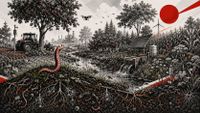
7. PHOTOSYNTHESIS — OR HOW LIGHT BECOMES SOIL
If syntropy is to be more than a beautiful word, the process must begin somewhere.
This process begins in a leaf — not in a certificate, not in a funding application and not in a pyrolysis plant.
That sounds almost banal. For us, a leaf is often merely a green surface, something that casts shade, falls from a tree, is raked up or ends that condition on lawns which some people mistake for nature: short, clean, green, kept to death. But a leaf is not decoration. It is a thin, living boundary surface between sun, air, water and earth.
There, photosynthesis takes place.
Plants take carbon dioxide from the air, water from the soil and energy from light. From these they build sugars and other organic compounds. Radiation becomes matter. Gas and water become leaf, root, blossom, fruit, wood, shade and, eventually, food for countless beings.
One can describe this chemically. One can write down formulae. One can explain it in schoolbooks until no child notices anymore that a planet is being fed here. But at its core it is immense: a plant stands there and makes form out of light.
That is precisely why bare soil is so absurd. Where sunlight meets a leaf, metabolism begins. Where sunlight meets bare earth, overheating often begins. Water evaporates, microorganisms come under stress, wind and rain meet less resistance. The surface becomes a wound.
An uncovered soil is not a sign of order. It is an open account.
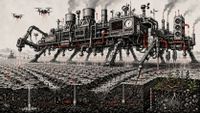
The mega-machine has few emotional problems with bare soil. It is clear and visible.
Machines pass through more easily, rows look tidy, control likes an unobstructed view. Living soil sees it differently. It wants to be covered. Life rarely leaves open places unoccupied for long. Not for aesthetic reasons, but for functional ones. Cover cools, protects, nourishes, slows the rain, reduces evaporation and keeps life at the surface able to work.
A soil without plant cover is like an organism without skin. One can survive that for a while. But one should not mistake it for a good condition.
Syntropic thinking therefore begins with a simple question: how much of the energy that falls on a site is transformed into living processes? How long do leaves work? How deeply and diversely do roots work? How much biomass arises not as waste, but as future food?
For the plant does not feed only us. It feeds the soil.
This does not happen only when leaves fall or roots die. It happens already during growth. Plants release part of the organic compounds they have made through their roots: sugars, organic acids, amino acids, mucilage and many other substances. These substances are called root exudates. The term sounds as though it had been invented by a committee for unpoetic technical vocabulary. But what it means is something very beautiful: the plant feeds its surroundings.
It gives sugar to the soil.
Not out of generosity in the human sense, of course. A plant is not a little green social club. It invests. With its exudates it feeds the rhizosphere, the immediate living space around the root. There, nutrients are made available, organic matter is transformed, crumbs are stabilised, water pathways are influenced, and pathogens are kept in check.
The plant feeds the soil so that the soil can feed the plant.
This is not a circle in the decorative sense. It is an economy. Only one that does not begin with money, but with light.
Here the question of biochar becomes interesting again. For carbon in the soil is not simply carbon in the soil. A piece of stable carbon can remain for a long time. In certain situations, that can be valuable. But living soil does not arise because carbon is deposited somewhere. It arises when carbon moves through relationships: through leaves, roots, exudates, soil organisms, mineral surfaces, pores and films of water.
Carbon in soil is not only a storage substance.
It is a relationship substance.
This is difficult for our culture to understand because it loves storage. Storage sounds solid, can be calculated and calms the nerves. But a living soil is not a vault. It is more like a stomach, a memory and a city at once: things are taken in, transformed, held, released, renewed, connected and sometimes lost.
Humus is therefore not a black drawer in which carbon is safely kept. Humus is the result of living processing. Its stability does not arise from standstill, but from recurring processes: microbial transformation, mineral binding, crumb structure, water movement and forms of use that strengthen or disturb these processes.
A forest does not store carbon like a warehouse. It stores it like a living body. In wood, roots, leaves, deadwood, fungi, soil life, water balance and microclimate. A forest is not stable because nothing happens in it. It is stable because a great deal happens — simultaneously, in many layers, with feedback.
Humus in the soil is not a black commodity. It is a biography. It tells whether a site was covered or bare, whether roots lived or were absent, whether water could slowly infiltrate or quickly ran off, whether organic residues remained or were removed. It tells whether agriculture was understood as metabolism or as an apparatus of extraction.
Here lies the difference between syntropic build-up and technical compensation. Technical compensation asks: how do we replace what is lost? Syntropic build-up asks: why is it being lost — and which natural processes must we strengthen so that loss does not become the basic direction?
This is not an argument against all technology. It is an argument against confusing technology with life. Tools can be very helpful: pruning shears, a pond, a composting site, even a pyrolysis plant. But tools are not the beginning. The beginning is the question of which process they serve.
Biochar can be useful under certain conditions. Or it can become the black sedative of a culture that prefers counting carbon to taking photosynthesis, roots, fungi and earthworms seriously.
The earthworm would probably have no balance sheet for this. But it would have an opinion.
For it, biomass is not a resource in the abstract sense. It is food, protection, moisture, temperature buffer, habitat. A withered leaf is not waste. A stalk is not a residue. A piece of wood is not unused potential.
It is the beginning of an underground conversation.
And this conversation almost always begins above.
In the light.
Soil-building does not begin with carbon.
It begins with photosynthesis.
Or more precisely: with the question of whether the energy that falls on a site is transformed into living relationships — or disappears as heat, evaporation and loss.
Entropy is the easier path.
A leaf is the beginning of a contradiction.
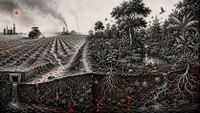
8. TERRA PRETA — OR THE CONFUSION OF SOIL AND RECIPE
Few terms have lent modern biochar as much lustre as Terra Preta, the dark earth of the Amazon region. It sounds like lost Indigenous wisdom, like fertile black earth in the midst of tropical soils, like a solution that is at once ancient, ecological and strikingly modern. Anyone wishing to sell or explain biochar therefore likes to reach for this image: centuries ago, people created fertile soils with charcoal. We need only do it again.
That is not wrong.
But it is dangerously abbreviated.
Terra Preta was not biochar from a sack. Not a standardised soil-improvement product. Not a climate certificate. Not an industrially produced carbon store with a data sheet and sales brochure. Terra Preta was soil that arose within a cultural, social, ecological and temporal context. Charcoal played an important role, but it was not alone. There were also organic residues, kitchen waste, bones, ash, pottery shards, faeces, nutrients, microorganisms, use, repetition, settlement, fire, time and soil life.
In other words: Terra Preta was not a substance. It was a process. Or more sharply: a living context that left traces in the soil.
This is where the modern confusion begins. A complex anthropogenic soil becomes a recipe, a historical metabolism becomes a product and grown fertility becomes a technical promise. Suddenly it sounds as though one only had to char biomass, put it into the soil, add a little compost, and the future would already be porous and climate neutral.
The earthworm would probably ask cautiously.
Not because it would be against charcoal — earthworms rarely conduct ideological debates about pyrogenic carbon — but because it knows the difference between living earth and black material. Porous charcoal can offer habitat, hold nutrients and store water. In poor, sandy or exhausted soils, it can be helpful. Properly incorporated, it can become part of a good compost or substrate.
Biochar is not the soil.
It is a component, not an organism.
It is structure, not metabolism.
It is a carrier, but not a living context.
The problem does not begin with biochar itself. The problem begins with the story built around it. It fits too well into the language of our time. It is measurable, stable, storable, transportable, standardisable and accountable. It allows carbon to be taken out of the untidy world of the living and brought into a calmer form. Stable substances are agreeable. They object less often than living processes.
This makes biochar seductive for the mega-machine.
It turns a living cycle into a technical object. It takes biomass that would otherwise be part of natural processes and turns it into something that lasts longer. In certain situations, that can make sense. But the decisive question is: which biomass is being charred — and from which living process is it first being withdrawn?
For biomass is not simply a raw material.
It is the food of the landscape: nourishment, protection, moisture, habitat and slow-acting erosion control for an immeasurable society beneath and upon the surface.
Anyone who chars biomass must therefore explain why, as a durable structure, it is more valuable than as slow food for soil, fungi, animals and microorganisms.
This is not a moral prohibition, but an ecological obligation to examine.
There are cases in which biochar can be plausible: when unavoidable residues arise, heat is used sensibly, problematic biomass cannot be better returned directly, and the char does not go raw into the soil but is charged with living, nutrient-rich substances. Then it can offer structure and support soil life. Then biochar can be a tool.
But a tool remains a tool.
A spade does not make a garden, pruning shears do not make syntropic agriculture, a pond does not make a functioning water balance, and biochar does not make Terra Preta.
Terra Preta reminds us of something else: fertility does not arise from isolated ingredients, but from relationships. The charcoal in these soils was embedded in organic residues, nutrients, ceramics, microorganisms, human settlement practices, repetition and time. It was not the hero of the story. More a porous supporting actor in a long, culturally shaped soil metabolism.
The modern biochar narrative likes to abbreviate this metabolism. It loves the part that remains stable. It has more trouble with the part that lives.
Life is untidy. Life smells, rots, ferments, crawls, eats, dies, grows back and can be pressed only to a limited extent into uniform product sheets. A compost heap has no elegant investor presentation. A mulch layer does not always look tidy. Deadwood still looks like a maintenance error to some people. A soil allowed to feed itself fits badly with a culture that only takes things seriously once they are packaged, certified and delivered with instructions for use.
Here Terra Preta becomes political as well. It shows that highly developed soil fertility can arise from a different logic: from cycles, proximity, organic return and a long relationship to a place. Not from an abstract resource that is extracted somewhere, processed somewhere, sold somewhere and accounted for somewhere.
Terra Preta was place-bound. Modern biochar is mobile. Terra Preta was embedded. Modern biochar is often isolated. Terra Preta was the result of a cultural metabolism. Modern biochar is often narrated as a technical solution.
That is precisely why caution is needed. Not to demonise biochar, but to remove it from the wrong throne. It can play a role, but it must not take the leading role. It must not be sold as soil-building where photosynthesis is absent, and it must not shine as climate protection where landscapes continue to dry out, soils lie bare, water runs off and biomass is pulled out of living cycles.
For that would be the real danger: that biochar does not save soil but relieves a culture that continues to treat soil wrongly.
If we take Terra Preta seriously, then not as a recipe, but as an indication. It shows that human beings can help shape fertile soils; that waste need not be waste; that culture need not inevitably mean destruction. But it also shows this: it is not about the single ingredient. It is about the context.
So, the question is not: biochar, yes or no?
The question is: does it serve the living process — or does it replace it in our imagination? Is it integrated — or scattered over an exhausted site as an indulgence certificate? Does more relationship arise — or only more stable carbon?
The earthworm remains sceptical. Not hostile. Merely experienced.
It knows that dead biomass is not dead if it can be eaten. It knows that a withered leaf can contain more future than a glossy climate balance. It knows that soil does not arise because carbon is deposited for the long term, but because life lets it pass through itself.
Perhaps that is the difference between Terra Preta and its modern shadow.
Terra Preta was black earth because a living context left traces.
Biochar is black carbon.
What becomes of it is decided not by the furnace.
It is decided by the soil.
9. BACK TO THE EARTHWORM
At the end, we stand once again where we began: with an earthworm in front of a pyrolysis plant. Only now the scene looks different.
At first it was absurd: a small creature of damp earth in a world of stainless steel, sensors, temperature curves, certificates and carbon balances. An earthworm presumably wondering why human beings heat, char, weigh and document its food, and then claim to be making soil from it.
Now it is clearer why this question reaches so deeply.
It is not addressed only to a technology. It is addressed to a way of thinking. To a culture that trusts the measurable more quickly than the living, understands carbon more easily than fertility, takes storage more seriously than metabolism and likes to find solutions where a process can be translated into a product.
Biochar is an excellent example of this. Not because it is fundamentally wrong. It can be useful, and it can be a tool. But a tool remains a tool. It becomes dangerous when a tool takes itself for the beginning.
The beginning does not lie in the char, not in the certificate, not in the stability of a substance. The beginning lies in the process the tool serves.
Is biomass removed from a living cycle, or is it used where it truly enables more life?
Is carbon being counted, or is fertility being built?
Is an exhausted system being technically soothed, or is its direction changing?
The mega-machine has learnt to speak green.
That is why green language is not enough.
It is not enough to speak of regeneration, to stabilise carbon, to invoke Terra Preta or to say syntropy while continuing to act entropically.
Syntropy is not a label. It is a test.
Not: how green does it sound?
But: what becomes more?
More life, more relationship and more capacity of the place to carry itself.
This is not a return to a pre-modern idyll. Nor is it a rejection of technology. Technology can serve: measure, help, cut, protect, plan, connect. But it must know whom it serves. As soon as it replaces the living process, the confusion begins. Soil becomes substrate, fertility becomes a metric, biomass becomes a raw material, Terra Preta becomes a sales argument — and the earthworm becomes a folkloric employee of a balance sheet it never signed.
Perhaps this is precisely the comic tragedy of our time. We possess incredible knowledge, sensors, laboratories, models, machines and databases. And yet we find it difficult to take the simplest thing seriously: that living soil does not arise from isolated substances, but from natural processes and relationships.
The earthworm is therefore not a romantic symbol. It is a concrete indication. Where it finds food, moisture, protection, organic matter and rest from constant disturbance, soil can live. Where it disappears, much can be measured. But one should not speak too quickly of fertility.
Perhaps this would be a simple rule:
If a climate-protection measure takes away the earthworm’s food, one should be able to explain very precisely why — not morally, but ecologically.
For soil-building does not begin with the question of how carbon can be fixed as permanently as possible. It begins with the question of how life can work on a site. How natural processes are not replaced but strengthened. How use does not merely extract but builds.
The mega-machine will not like this question. It is hard to standardise. But perhaps that is precisely its value.
For not everything that counts can be easily counted, and not everything that can be counted tells the truth of the soil.
In the end, then, the earthworm remains beside the pyrolysis plant, somewhat irritated but by no means defeated. It does not understand the diagrams. It does not know the certificates. It does not know what negative emissions are. But it knows what food is, what moisture is, and what darkness, protection, organic matter and a breathing soil mean.
Perhaps that is enough for the beginning.
For soil does not begin in the laboratory, not in the certificate, not in the furnace and not in the market.
It begins where a leaf catches light, a root gives off sugar, a fungus responds, an earthworm eats, and dead biomass becomes living fertility again.
There lies the beginning.
SOURCES AND LINES OF THOUGHT BY CHAPTER
Note: The sources are intended as lines of evidence for the themes addressed in the essay. The text itself is essayistic in form and does not use the sources as continuous footnotes.
A selection of central sources for the essay The Earthworm in the Mega-Machine
All internet sources last accessed on 4 July 2026.
1. The Earthworm in the Mega-Machine
Pyrolysis, biochar, Biochar Carbon Removal and European climate policy
This opening chapter connects the image of the pyrolysis plant with the current political and economic upgrading of biochar as a possible form of permanent carbon removal. What matters here is not only the technology itself, but its integration into certification logics, carbon markets and climate balances.
European Commission: EU sets world’s first voluntary standard for permanent carbon removals, 3 February 2026.
https://climate.ec.europa.eu/news-other-reads/news/eu-sets-worlds-first-voluntary-standard-permanent-carbon-removals-2026-02-03_en
Accessed: 4 July 2026
European Commission: Certification methodologies — permanent carbon removals / Biochar Carbon Removal.
https://climate.ec.europa.eu/eu-action/carbon-removals-and-carbon-farming/certification-methodologies_en
Accessed: 4 July 2026
EUR-Lex: Regulation (EU) 2024/3012 — Carbon Removals and Carbon Farming Regulation.
https://eur-lex.europa.eu/eli/reg/2024/3012/oj/eng
Accessed: 4 July 2026
2. The Mega-Machine Loves the Measurable
Technology, administration, certification, social criticism
The term mega-machine follows the line of technological and cultural criticism associated with Lewis Mumford. It does not refer merely to a large machine, but to a social, administrative, technical and economic form of organisation. Murray Bookchin’s social ecology complements this perspective by showing that domination of nature and social forms of domination cannot be understood separately.
Lewis Mumford: The Myth of the Machine.
https://books.google.com/books/about/The_Myth_of_the_Machine.html?id=-R9mAAAAMAAJ
Accessed: 4 July 2026
Murray Bookchin: The Ecology of Freedom.
https://theanarchistlibrary.org/library/murray-bookchin-the-ecology-of-freedom
Accessed: 4 July 2026
European Parliament: Certifying EU permanent carbon removals: State of play in 2026.
https://www.europarl.europa.eu/thinktank/en/document/EPRS_BRI%282026%29785709
Accessed: 4 July 2026
3. Entropy — or Why Disorder Is the Easier Path
Thermodynamics, the direction of time, information, Gerd Ganteför
Gerd Ganteför was particularly important for the physical-philosophical tension of this chapter. His reflections on entropy, the direction of time and information inspired several thought-images in the essay: the dice, the pocket watch and later the cautious speculation about information as a possible basic category of reality. These thoughts are not adopted as a secured formula for the world, but as a productive line of thought.
Gerd Ganteför: Die Intelligenz des Universums. Die immaterielle Komponente der Wirklichkeit, Westend Verlag, 2026.
https://westendverlag.de/Die-Intelligenz-des-Universums/2410
Accessed: 4 July 2026
YouTube channel Grenzen des Wissens by Gerd Ganteför.
https://www.youtube.com/channel/UCxXmS6BkfhCALrPyCJKmPyg
Accessed: 4 July 2026
Encyclopaedia Britannica: Entropy.
https://www.britannica.com/science/entropy-physics
Accessed: 4 July 2026
4. The Pocket Watch, the Bacterium and the Insolence of Life
Biological precision, cell, molecules, organised activity
This chapter uses the pocket watch not as a theological proof, but as a thought-image for the improbability of complex order. The biological point is that a cell is not simply a constructed object, but an open, self-maintaining system. The following sources help situate cell size, molecular scales and biological organisation.
Milo / Phillips: Cell Biology by the Numbers.
https://book.bionumbers.org/
Accessed: 4 July 2026
BioNumbers — database for quantitative biology.
https://bionumbers.hms.harvard.edu/
Accessed: 4 July 2026
RCSB Protein Data Bank: Molecule of the Month.
https://pdb101.rcsb.org/motm/
Accessed: 4 July 2026
5. LUCA — or Why the Beginning Was Already Not the Beginning
Early life, Earth history, last universal common ancestor
The statements about LUCA are based above all on the current reconstruction in Nature Ecology & Evolution. What matters for the essay is not only the dating to about 4.2 billion years ago, but also the insight that LUCA was not the origin of life, but already the result of a deeper pre-LUCA history. The Earth’s age, about 4.54 billion years, helps make visible how early cellular life must be placed in Earth history.
Moody et al.: The nature of the last universal common ancestor and its impact on the early Earth system, Nature Ecology & Evolution, 2024.
https://www.nature.com/articles/s41559-024-02461-1
Accessed: 4 July 2026
PubMed entry for the LUCA paper.
https://pubmed.ncbi.nlm.nih.gov/38997462/
Accessed: 4 July 2026
U.S. Geological Survey: Age of the Earth.
https://pubs.usgs.gov/gip/geotime/age.html
Accessed: 4 July 2026
6. Ernst Götsch — or How a Difficult Word Suddenly Becomes Necessary
Syntropic agriculture, succession, pruning, living processes
Ernst Götsch is the central reference for syntropic agriculture. For the essay, what matters less is a method in the narrow sense than a movement of thought: agriculture not as the control of a surface, but as a reading and guiding intervention in already existing living processes — succession, pruning, biomass, photosynthesis and soil life.
Agenda Götsch — official page on Ernst Götsch and syntropic agriculture.
https://agendagotsch.com/en/
Accessed: 4 July 2026
Agenda Götsch: Syntropy.
https://agendagotsch.com/en/syntropy/
Accessed: 4 July 2026
Syntopia Agroforst: Syntropic Agriculture.
https://syntopia-agroforst.com/en/syntropic-agriculture/
Accessed: 4 July 2026
7. Photosynthesis — or How Light Becomes Soil
Photosynthesis, root exudates, soil life, humus
This chapter supports the central distinction of the essay: soil fertility does not arise through the mere deposition of carbon, but through photosynthesis, roots, root exudates, microbial processing, mineral binding, soil structure and water movement. Humus appears here not as a simple black substance, but as the result of ongoing processes.
Umweltbundesamt: Humusstatus der Böden.
https://www.umweltbundesamt.de/daten/flaeche-boden-land-oekosysteme/boden/humusstatus-der-boeden
Accessed: 4 July 2026
Thünen Institute: Organische Bodensubstanz.
https://www.thuenen.de/de/fachinstitute/agrarklimaschutz/arbeitsbereiche/organische-bodensubstanz
Accessed: 4 July 2026
praxis-agrar.de: Humus ist anders als gedacht — die neue Humustheorie.
https://www.praxis-agrar.de/pflanze/boden/humus-ist-anders-als-gedacht
Accessed: 4 July 2026
FiBL: Humuswirtschaft. Humus aufbauen — Bodenfruchtbarkeit erhalten.
https://www.fibl.org/fileadmin/documents/shop/1314-humuswirtschaft.pdf
Accessed: 4 July 2026
8. Terra Preta — or the Confusion of Soil and Recipe
Biochar, Amazonian Dark Earths, cultural soil metabolism
These sources help us understand Terra Preta not as a simple biochar recipe, but as a historical, cultural and ecological soil metabolism. Biochar can play a useful role, but it is no substitute for photosynthesis, roots, soil life, organic return and time.
Ithaka Journal: Terra Preta — Modell einer Kulturtechnik.
https://www.ithaka-journal.net/terra-preta-modell-einer-kulturtechnik
Accessed: 4 July 2026
Schmidt et al.: Intentional creation of carbon-rich dark earth soils in the Amazon, Science Advances, 2023.
https://www.science.org/doi/10.1126/sciadv.adh8499
Accessed: 4 July 2026
Free full-text version of the paper on Amazonian Dark Earths.
https://pmc.ncbi.nlm.nih.gov/articles/PMC11320335/
Accessed: 4 July 2026
German Biochar: Wurzelapplikation von Pflanzenkohle — hohe Ertragssteigerung mit wenig Pflanzenkohle.
https://german-biochar.org/wurzelapplikation-von-pflanzenkohle-hohe-ertragssteigerung-mit-wenig-pflanzenkohle/
Accessed: 4 July 2026
9. Back to the Earthworm
Closing motif, soil-building, technology as tool
The final chapter brings together the main thesis: technology can help, but it must not be confused with the living process. Soil-building does not begin with the stabilisation of a substance, but with the strengthening of living processes: photosynthesis, roots, fungi, animals, microorganisms, water, organic matter and time.
Umweltbundesamt: Bodenlebewesen und ihre Bedeutung für Bodenfunktionen.
https://www.umweltbundesamt.de/themen/chemikalien/pflanzenschutzmittel/problematik-bei-zulassung-einsatz/bodenlebewesen-werden-durch-pflanzenschutzmittel
Accessed: 4 July 2026
FiBL: Humuswirtschaft. Humus aufbauen — Bodenfruchtbarkeit erhalten.
https://www.fibl.org/fileadmin/documents/shop/1314-humuswirtschaft.pdf
Accessed: 4 July 2026
European Commission: Carbon removals and carbon farming.
https://climate.ec.europa.eu/eu-action/carbon-removals-and-carbon-farming_en
Accessed: 4 July 2026
On the Use of Sources
Not all the sources named here stand on the same level. Ganteför provides thought- and image-impulses at the boundary of physics, cosmology and philosophy. Lovelock, Margulis, Moody et al., the soil science sources, Terra Preta research and EU documents secure key technical lines. Mumford and Bookchin provide the deeper layer of social criticism. Ernst Götsch and syntropic agriculture return the text to practice: pruning, succession, biomass, photosynthesis, soil life.
The essay deliberately moves between these levels. Its main thesis is not that biochar is wrong. It is that soil-building begins not with the stabilisation of a substance, but with the strengthening of living processes. Technology can help. But it must not be confused with life.
The illustrations were created with the help of ChatGPT 5.5 in the “resonance space of resistance”.