NEOPHYTES AND THE ELEPHANT IN THE ROOM
Why we would rather fight plants than understand our landscapes
There are words that sound harmless until you start listening to them.
“Neophyte control” is one of those words. It appears on information boards, in maintenance plans, nature conservation programmes and municipal newsletters. It sounds factual, technical, almost hygienic, as if it were merely a necessary measure of order in the green outdoor space. But if you listen more closely, you notice that this is not only description; it is judgement. Something is foreign, invasive, disruptive, not belonging. And because it does not belong, it has to go.
That is how simple the world is. At least on the information board.
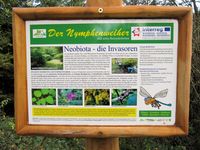
Nature itself is rarely so cooperative. Plants do not grow because they have been listed as problem species in an administrative folder. They grow because conditions arise under which they can grow. They use bare soils, disturbed riverbanks, over-fertilised sites, missing shade, compacted edges, straightened streams and landscapes from which diversity has been driven out.
Neophytes are therefore rarely the cause of an ecological disturbance. More often, they are its visible sign. A symptom. Sometimes perhaps even a provisional repair measure by nature: an attempt to cover open wounds, bind nutrients, shade the soil, build biomass or bring vegetation back to a disturbed site in the first place.
This does not mean that every spread is without consequence. But it does make the usual narrative questionable. When a plant appears en masse, the decisive question should not first be how we get rid of it. The more interesting question is: what has happened here that makes this particular plant so successful now?
What is striking is how quickly nature conservation slips into the language of warfare when certain plants are involved. They are fought, contained, pushed back, eliminated, eradicated. The terms arrive in rubber boots and with brush cutters, but intellectually they are wearing uniforms.
That is remarkable. Biology is, after all, the science of life. Ecology is the study of relationships, cycles and interactions. One might therefore expect the first questions to be: which relationship has been disturbed, what function does this plant perform in this place, which site conditions favour its spread, and what is missing here in terms of structure, shade, competition, soil life or water balance?
Instead, the visible species is often declared the opponent.
That is convenient. A plant can be pulled out. Japanese knotweed can be mapped. Himalayan balsam can be removed in volunteer actions. This produces photographs, work campaigns, funding reports and the reassuring feeling of having done something. A disturbed water balance cannot be pulled out quite so easily. An agricultural landscape that has been cleared out for decades does not fit into a rubbish bag. And the loss of living soil processes cannot be tackled on a Saturday morning with gloves and good intentions.
Perhaps the problem begins even earlier: in the language with which we describe nature in the first place. We speak of the “environment”, as if the living world were something arranged around us. The human being stands at the centre; everything else forms the surroundings. Depending on need, these surroundings are used, protected, assessed, maintained, optimised or managed.
That sounds reasonable. But it is not neutral.
Those who speak of the environment can easily imagine themselves outside it. Those who speak of a co-world stand within it. Co-world means that we are not the administrators of an external natural backdrop. We are part of a fabric of soil, water, air, plants, animals, fungi, microorganisms, climate, use and history. We do not live beside these processes. We live through them.
This shift is more than linguistic cosmetics. It changes the underlying attitude. Control becomes relationship. Use becomes responsibility. A nature that surrounds us becomes a world in which we are entangled with everything else.
Other terms also betray us. “Ecosystem services”, for example. The concept has undoubtedly achieved something. It has made visible that forests, soils, wetlands, meadows, water bodies and insects are not worthless simply because they do not appear in a conventional balance sheet. They store water, cool the air, form soil, bind carbon, enable pollination, filter substances and create habitats. That mattered.
And yet a stale aftertaste remains. The term translates living relationships into the language of utility, function and performance. The tree provides shade. The soil stores carbon. The bee pollinates. The stream retains water. The forest delivers cooling. Nature, it seems, is working in some sort of unpaid service sector. One almost wants to ask whether it is at least covered by social insurance.
The problem is not that these functions are wrong. The problem is that they are incomplete. A tree does not exist because it lowers our air temperature. A stream is not valuable because it buffers flood peaks. A soil does not live in order to stabilise our yield targets. A plant does not become meaningful only when it is useful, native, eligible for funding or biodiversity-enhancing. Living systems have more than utility value. They have intrinsic value. And they stand in relationship with us long before we begin to calculate their services.
The term “landscape maintenance” is particularly revealing. It sounds caring, almost tender. Who could be against care? And yet it often contains a very human presumption. Landscape appears as something that must be kept orderly by us: mown, cut back, opened up, thinned, cleaned, de-shrubbed, calmed, regulated. Maintenance then often means that the landscape should please look the way we know it from a particular cultural-historical moment, or the way it fits into our aesthetic system of order.
A meadow may be species-rich, but not untidy. A stream may be near-natural, but not too self-willed. A forest edge may be structurally rich, but please not chaotic. A fallow site may be ecologically valuable, as long as it does not look neglected. In this way, landscape maintenance sometimes becomes the polite form of control.
Of course, cultural landscapes need use, mowing, grazing, pruning, care and interventions. No one needs to pretend that doing nothing is always ecologically wiser. But the question is whether we are caring in order to enable life, or whether we are caring so that liveliness does not get too far out of shape. The difference is decisive. A living landscape is not automatically an orderly landscape. And an orderly landscape is not automatically a healthy one.
The same applies to “water management”. This term, too, is understandable. Municipalities, farms, planners and designers need strategies for heavy rainfall, drought, erosion, flooding and overheating. Technical planning is necessary. But here, too, a second look is worthwhile. Management suggests organisation, steering, control. Water appears as a material flow that must be regulated: drained, collected, throttled, captured, stored, used.
This is often necessary. But it is only part of reality. Water is not merely a technical quantity. It is a living landscape process. It relates to soil pores, roots, fungi, microorganisms, humus, landforms, shade, evaporation, plant growth and local cooling. Water does not simply move through landscape. Water helps form landscape.
Perhaps we should therefore be more cautious about the idea that water can be managed as if it were a somewhat disorderly employee in a poorly organised office. It is not only about steering water. It is about developing landscapes in such a way that water can remain again: in the soil, in hollows, in wet zones, in vegetation, in evaporation, in living cycles. The goal is not control over water, but the restoration of a water balance to which we ourselves belong.
In many debates about neophytes, there is an elephant in the room. It is large, hard to overlook, and for decades it has been quite visibly trampling on soil life, water balance and biodiversity. Nevertheless, many prefer to talk about the Himalayan balsam along the stream.
The elephant is called industrial land use.
Monocultures, heavy machinery, regular tillage, drainage, straightened watercourses, nutrient surpluses, herbicides, insecticides, fungicides, the loss of hedgerows and margins, missing woody structures, compacted soils and emptied-out landscapes are not background noise. They are central causes of ecological instability. Soils lose humus. Water runs off too quickly. Erosion increases. Water bodies are polluted. Insects disappear. Landscapes become hotter, drier and more vulnerable. Ecological self-regulation is weakened.
And then we are surprised when certain plant species use the gaps that have been created.
It is rather like neglecting a house for years, removing the roof, taking out the windows, leaving the doors open – and then complaining about the dandelion in the living room. Of course one can remove the dandelion. But perhaps one should also talk about the roof.
The term “foreign” is, in any case, less clear than it sounds. Many plants that are now taken for granted in our food and agriculture came to Europe through human cultural history: potatoes, tomatoes, maize, pumpkins, beans, sunflowers and many fruit varieties. They are not accepted because they are always ecologically unproblematic. They are accepted because they are useful.
Maize is a particularly telling example. It does not originate from Central Europe, yet it shapes entire landscapes. No one seriously speaks of maize control, although intensive maize cultivation is in many places associated with tillage, erosion, herbicide use, nutrient losses, humus depletion and a strong simplification of the landscape.
For decades, agricultural soils have been and continue to be burdened with herbicides, insecticides, fungicides and other chemical active substances. This is not only about individual substances, but about mixtures – chemical cocktails whose long-term effects on soil life, water, insects, plants, animals and humans are only partly understood.These substances do not reliably remain on the treated field. They can enter adjacent habitats, settlements, forests, water bodies and protected areas via wind, dust, water, evaporation, drift and erosion. Pesticide residues have also been detected in studies outside agricultural land.
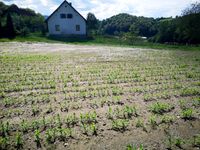
Even so, public attention often focuses more strongly on the “wrong” plant at the edge than on the chemical and structural burden placed on entire landscapes. This is not a factual necessity. It is a cultural decision.
The debate about neophytes therefore touches on another, more delicate level. Its language is, in places, strikingly reminiscent of political debates about migration: foreign, invasive, introduced, displacing, threatening, not belonging, to be fought.
Of course, plants are not people. Ecological processes are not the same as social questions. These levels must not be crudely equated. But the linguistic patterns are hard to overlook. In the nature debate, too, arguments are often made in terms of belonging, origin and purity. Some species are considered right, others wrong. Some belong, others do not. Some are protected, others fought. The place of origin becomes more important than the concrete relationship at the respective site.
That should make us cautious. For as soon as we sort complex realities primarily into categories of native and foreign, pure and disruptive, belonging and not belonging, origin becomes the explanation. Then we overlook conditions, relationships, power structures and causes. We seek responsibility in what becomes visible – not in the systems that produce this visibility.
With neophytes, this means that the plant on the disturbed streambank is declared the problem, while straightening, nutrient inputs, missing shade, soil disturbance and industrial land use recede into the background. That is the actual parallel. Not because plants are people, but because our language shows how quickly we use foreignness as an explanation when we do not really want to look at disturbed systems.
Another misconception lies in the idea that nature is a static condition that can be conserved. As if there were an ideal list of species, an original order, a correct image of landscape that merely had to be defended against intruders. But nature is movement. Species migrate. Climate zones shift. Soils develop. Disturbances occur. Communities of life change. The human being has long been part of this dynamic – not as a neutral observer, but as a shaping force.
This does not mean that everything is irrelevant. It does not mean that every spread should be ignored. Nor does it mean that protected areas, rare species or sensitive habitats are unimportant. But it does mean that we must distinguish more carefully. It makes a difference whether a plant appears in a highly sensitive remnant habitat with rare species, or whether it grows on a disturbed embankment, a torn-up riverbank, an over-fertilised fallow area or a compacted roadside. In the first case, targeted intervention may be sensible. In the second, the more important question is why this site is so disturbed that precisely this plant dominates there.
Perhaps we should see many neophytes less as enemies and more as diagnostic instruments. They indicate bare soils, nitrogen surpluses, disturbed banks, missing shade, compacted sites, monotonous landscapes and areas where natural succession has been interrupted. They show that ecological self-regulation has been weakened.
If such a plant is removed without changing the site conditions, often all that is created is a new bare patch. And that patch will be colonised again – by the same species or by another one. Then the control work starts all over again. This is not management. It is an ecological hamster wheel.
It would be more sensible to reverse the question. What conditions would need to arise for a diverse, stable, living plant community to grow? What would a riverbank have to be like so that it does not need to be constantly “cleaned”? How would a soil have to be treated so that it does not lie open, compacted and exhausted? How would a landscape have to be structured so that individual pioneer species do not have to take over the few remaining functions?
A different approach to neophytes would not mean doing nothing. It would mean acting differently. Not reflexively fighting, but first observing. Not only removing, but changing causes. Not leaving bare soils behind, but covering them. Not clearing riverbanks, but shading and enlivening watercourses again. Not considering individual species in isolation, but understanding site, use and water balance. Not working against natural processes, but with them.
This includes living soils, permanent cover, woody structures, hedgerows, margins, wet zones, retention areas, diverse uses, less chemical pressure, less soil disturbance and more room for succession. Stable, diverse systems are usually less susceptible to the dominance of individual species. Not because these species have been eradicated, but because ecological relationships have become denser again.
Genuine nature conservation therefore does not begin with the question of which species we want to remove. It begins with the question of which living conditions we create. How do we keep water in the landscape? How do we build humus? How do we protect soil life? How do we reduce chemical burdens? How do we create shade, structure and transitions? How do we connect habitats? How do we enable diversity in use and vegetation? How do we shape agriculture so that it works not against ecological processes, but with them?
If we take these questions seriously, our view of neophytes changes as well. Individual plants are no longer at the centre; the systems in which they appear are. The decisive question is no longer which plants do not belong. It is why a system has fallen out of balance, what role humans play in that, and how landscapes can become more diverse, more stable and more self-regulating again.
Perhaps we need fewer enemy images in nature and more precision in our thinking. Fewer moral judgements about plants. More attention to causes. Less rhetoric of control. More ecological literacy. Less symptom treatment. More responsibility for the way we use landscapes.
Neophytes are not the cause of damaged landscapes. They are often their visible sign. They appear where soils, water balances, habitats and uses have already been changed.
The elephant in the room is not the Himalayan balsam along the stream, the Japanese knotweed on the embankment or the black locust by the wayside. The elephant in the room is a form of land use that simplifies, burdens and destabilises living systems – and then holds individual plants responsible for the fact that nature no longer looks the way we would like it to.
A more mature ecological attitude would not first ask what we must eradicate.
It would ask what we can bring back to life.
ESSAYISTIC SOURCE NOTE
This source note is deliberately not designed as an academic apparatus of footnotes. The article works essayistically: it does not assemble a technical species list, but asks what our language, our image of nature and our treatment of cause and symptom reveal. The following notes therefore name only a few load-bearing sources, in the order in which the argument unfolds.
1. On the language of alienness and the management of neophytes
The article begins with the common language of “invasive alien species” and reads it deliberately against the grain. The IPBES report is useful precisely because it represents the international science-policy mainstream with great clarity: invasive alien species are described as a significant driver of biodiversity loss, and prevention, control and management are central concepts. The essay does not deny that this framework can be necessary in specific cases. It asks, however, what is lost when the visible species becomes the main object of attention while the disturbed conditions that made its dominance possible move into the background.
Source: IPBES (2023/2024): Summary for Policymakers of the Thematic Assessment Report on Invasive Alien Species and their Control. IPBES secretariat, Bonn / Zenodo. Download / DOI · Accessed: 30 July 2026.
2. On “ecosystem services”, management language and the limits of functional concepts
The passages on environment, Mitwelt, ecosystem services, landscape maintenance and water management stand within a wider debate about the value and the limits of functional concepts of nature. The Millennium Ecosystem Assessment strongly shaped the term “ecosystem services” and made it influential in policy, planning and economics. The essay acknowledges this achievement, but also points to the conceptual narrowing that can occur when living relationships are translated almost entirely into services, functions and management tasks.
Source: Millennium Ecosystem Assessment (2005): Ecosystems and Human Well-being: A Framework for Assessment. Online / download chapter · Accessed: 30 July 2026.
3. On the elephant in the room: industrial land use, pesticides and landscape space
For the section on maize, industrial agriculture and chemical pollution, a German-language source is particularly important. The Austrian Environment Agency’s report on pesticide monitoring in ambient air shows that pesticide transport through the air is not merely an abstract risk, but a measurable phenomenon. For the essay, this source is less a detailed toxicological proof than an indication that the chemical and structural burden placed on whole landscapes deserves at least as much attention as the plant growing on a disturbed edge.
Source: Umweltbundesamt Österreich (2025): Pestizidmonitoring in der Umgebungsluft. REP-0946, Vienna. PDF download · Accessed: 30 July 2026.
Note on use
These three sources are sufficient for a concise and elegant source note for the website version: one source for the international neophyte/invasion discourse, one for the concept of ecosystem services, and one German-language source on pesticide transport through the atmosphere. Anyone wishing to develop the article into a more academic version could add further literature on invasion biology, landscape ecology, pesticide drift, environmental ethics and the critique of ecosystem-service economics.